How to Create Historical YouTube Shorts with AI
A Research-First Production Workflow
Historical YouTube Shorts work best when a compelling story is built on evidence, a clear timeline, and honest distinctions between documented facts and interpretation. AI can speed up outlining, drafting, visual development, and editing—but it cannot verify the past for you. This guide shows how to research one event, turn it into a concise script, create historically responsible visuals, and publish with appropriate disclosures and rights checks.
A strong history Short does more than summarize dates. It gives viewers a specific question, explains what the evidence supports, and leaves out details that cannot be verified. Use the workflow below for ancient, medieval, and modern history alike.
Important: A realistic AI reconstruction is an illustration, not archival evidence. Do not present generated scenes, invented dialogue, or synthetic quotations as authentic historical footage or testimony. Check dates, names, translations, image rights, and platform rules before publishing.
1. Build a Reliable Research File Before Writing
Start with one answerable question rather than a broad subject such as “the Roman Empire.” A focused question gives the Short a narrative direction and makes fact-checking manageable. Examples include: What changed after a particular battle? Why did a city build a defensive wall? What do surviving records actually tell us about a ruler’s decision?
Use primary and secondary sources for different jobs
Primary sources come from the period being studied or are direct evidence connected to it: letters, inscriptions, official records, diaries, maps, photographs, archaeological objects, or contemporary accounts. They can reveal what a person or institution recorded, but they are not automatically neutral or complete. Consider who created the source, when, for whom, and with what purpose.
Secondary sources are later analyses by historians, archaeologists, museums, and academic researchers. Use them to understand context, compare interpretations, and locate the evidence behind a claim. A useful starting point is the United States Holocaust Memorial Museum’s guide to identifying reputable historical sources, which explains why reliability, context, and hindsight matter.
Create a simple claim-check table
| Claim in your script | Evidence to locate | Decision before publishing |
|---|---|---|
| A battle happened on a specific date | Contemporary records plus a reputable modern chronology | Use the date only if the evidence supports that level of precision; otherwise say “around” or give the year. |
| A ruler gave a memorable speech | A traceable contemporary account or a reliable scholarly discussion | Do not invent direct dialogue. Paraphrase the source and identify it as an account if needed. |
| An army had a particular size | Specialist research explaining the estimate and its uncertainty | Avoid false precision. Historical troop numbers are often disputed or based on incomplete evidence. |
| A visual shows a uniform, weapon, or building | Museum collections, archaeological publications, dated images, or specialist references | Correct the design or label the scene as an artistic reconstruction. |
Keep a research note for every important statement: the claim, the source title and link, the relevant page or passage, and any uncertainty. This makes revisions easier and helps you answer viewers who ask where a detail came from.
2. Choose a Story That Fits a Short Video
A short video cannot responsibly explain an entire war, dynasty, or civilization. Choose one turning point, decision, object, misconception, or consequence. A useful story can be organized around three questions:
- What happened? State the event and the minimum context viewers need.
- Why did it matter? Explain the cause, consequence, or historical significance without exaggeration.
- What do we know—and not know? Separate established evidence from debate, legend, or later retelling.
Avoid framing every event as a hidden secret, a forgotten truth, or a shocking revelation. Those phrases are only justified when the evidence genuinely supports them. A precise question is usually more engaging and more trustworthy than manufactured suspense.
3. A Tool Stack to Test for History Channels
Choose tools according to the job, your budget, and the rights attached to each output. Product features, model names, prices, and commercial-use terms change, so check the provider’s current documentation before committing to a workflow.
| Production stage | Tools to evaluate | Practical note |
|---|---|---|
| Research and scripting | Claude or ChatGPT | Ask for an outline and questions to investigate. Verify every historical claim independently; language models can invent citations and details. |
| Reference research | Museum collections, university publications, national archives, and specialist books | Use these to check dates, objects, maps, clothing, architecture, and competing interpretations. |
| Visual keyframes | Midjourney or Leonardo AI | Generate illustrative scenes only after preparing a period-specific reference sheet. Review details for anachronisms. |
| Image-to-video motion | Kling AI or Runway | Animate selected frames where movement helps explain the action. Inspect hands, faces, weapons, lettering, and architecture frame by frame. |
| Voiceover | ElevenLabs or another properly licensed text-to-speech service | Check pronunciation of names and places. Confirm commercial rights and never clone another person’s voice without permission. |
| Editing and captions | CapCut or your preferred video editor | Use captions, maps, source notes, and sound to clarify the story—not to disguise weak research. |
4. Step 1: Write a Historically Responsible Script
Open with a question, contradiction, or verified detail that creates curiosity. Then establish the time and place, explain the central event, and finish with its consequence or an honest note about uncertainty. Do not force a date-first opening, but do not hide the date when it is essential to understanding the story.
Act as a careful historical documentary scriptwriter for YouTube Shorts. Create a concise script about [HISTORICAL EVENT] for an audience unfamiliar with the subject.

Research rules:
1. Use only the facts and source notes I provide below. Do not invent dates, quotations, motives, numbers, or eyewitness details.
2. Mark any claim that needs verification as [CHECK SOURCE]. If historians disagree, state that the interpretation is disputed.
3. Do not write invented dialogue as a real quotation. Do not present an AI reconstruction as archival footage.
4. Explain the event in chronological order and distinguish documented fact from interpretation.

Story structure:
- Opening: one accurate question or specific detail that earns attention.
- Context: the time, place, and people viewers need to know.
- Main event: explain what happened in clear, short sentences.
- Significance: show why the event matters and what is still uncertain.
- Ending: a concise conclusion, not a fabricated cliffhanger.

Target length: [WORD COUNT OR RUNTIME]. Use natural spoken English, avoid filler, and add [VISUAL] cues only when they help explain the story.

Source notes:
[PASTE VERIFIED CLAIMS, SOURCE TITLES, LINKS, AND UNCERTAINTIES HERE]Read the script aloud and time it. Word count is only an estimate because narration speed, pauses, names, and visual breaks affect the final runtime. Remove sentences that repeat the same fact, but keep context that prevents a misleading interpretation. For a timing estimate, use our Script Timing Counter.
Example: turn a broad topic into a focused episode
Instead of asking an AI tool to “tell the whole story of the Bronze Age Collapse,” narrow the assignment to one question, such as how evidence from a particular settlement contributes to historians’ understanding of disruption in the eastern Mediterranean. Your research file should identify the site, the period being discussed, the archaeological evidence, and which parts of the explanation remain debated. The script can then explain one piece of evidence without pretending that a complex historical process has one universally agreed cause.
5. Step 2: Generate Visuals That Respect the Period
A consistent visual direction helps a series feel cohesive, but cinematic style is not historical accuracy. Before generating images, create a short reference sheet for the scene: approximate date and region, clothing, materials, architecture, tools, weapons, transport, climate, and any details that are uncertain. Use museum or academic references to check those choices.
When the evidence does not establish an exact appearance, use a broad, plausible illustration and avoid presenting it as a precise reconstruction. Do not combine objects from different centuries just because the result looks dramatic.
Master Prompt A: Ancient and Classical Era
Create a stylized cinematic historical illustration of an ancient Roman military commander inside a field tent, studying a parchment campaign map by torchlight. Use only the period details in this reference brief: [INSERT VERIFIED DATE, REGION, CLOTHING, ARMOR, EQUIPMENT, AND SETTING]. Do not add later medieval objects, fantasy armor, modern materials, readable invented text, or historically unsupported symbols. The scene is an artistic reconstruction, not a real photograph or archival record. Vertical 9:16 composition, clear focal subject, restrained dramatic lighting, historically plausible materials, no captions or watermark.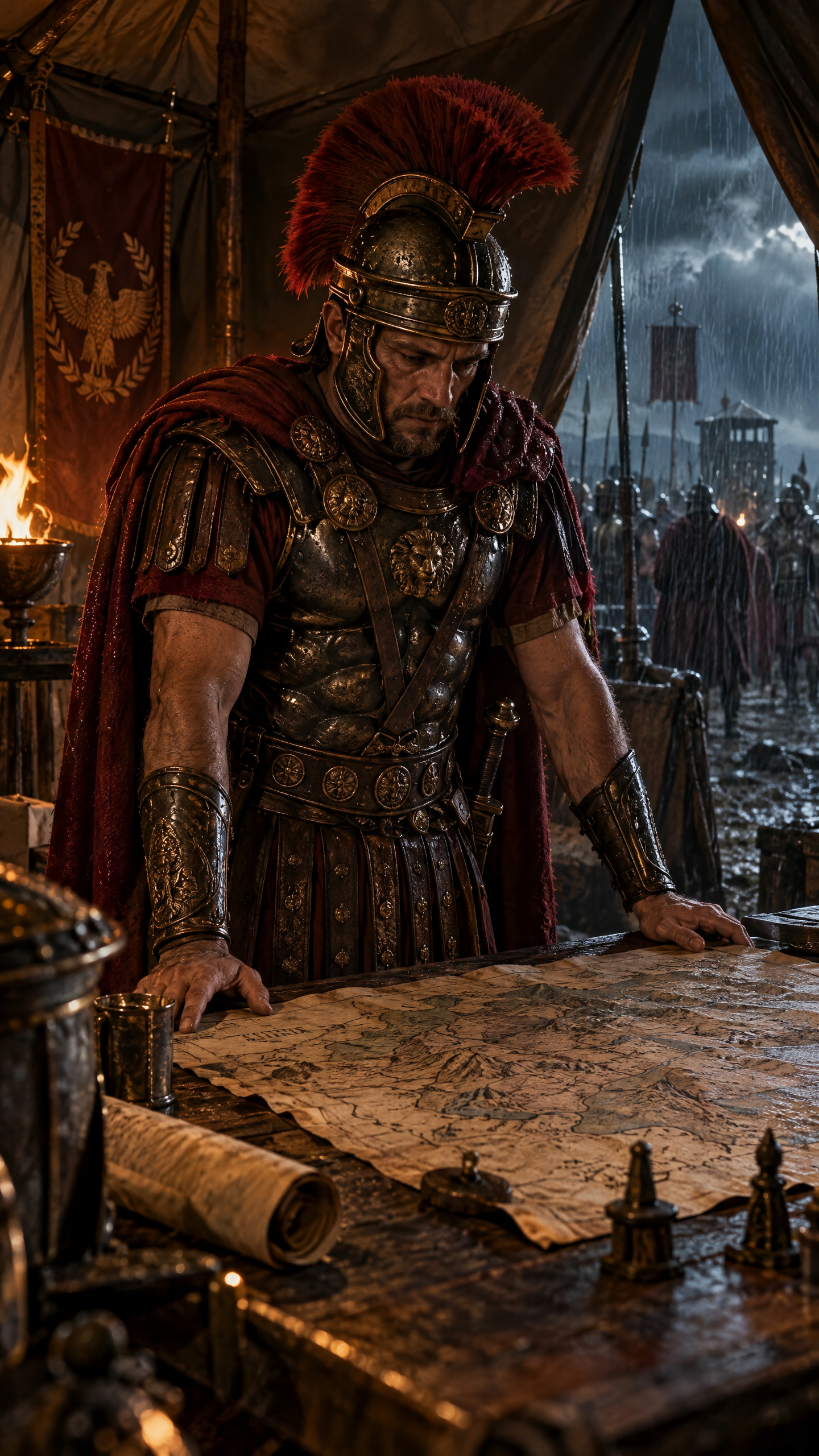
Master Prompt B: Medieval Europe
Create a historically cautious illustration of a European town in the [INSERT VERIFIED CENTURY AND REGION]. Show a physician or resident wearing clothing supported by references for that specific place and period. Do not automatically use the later beaked plague-doctor costume unless the date and evidence justify it. Specify the architecture, street surface, lighting sources, tools, and materials using this reference brief: [PASTE VERIFIED DETAILS]. Do not invent a documented individual, quotation, emblem, or event. The result is an AI-generated illustration, not archival footage. Vertical 9:16 framing, coherent period details, no text or watermark.Use a visual continuity checklist
- Keep the same character description, clothing, age range, and equipment across shots.
- Check that buildings, weapons, flags, maps, and writing fit the stated period and region.
- Do not generate a recognizable historical person in a fabricated scene that could be mistaken for an authentic record.
- Remove malformed text, distorted objects, extra fingers, and visual details that change the meaning of the scene.
- Keep a note identifying which shots are AI-generated illustrations or reconstructions.
6. Step 3: Animate Scenes Without Changing the Facts
Choose motion to support the narration: a slow camera move can reveal a map, a measured pan can show a city layout, and a restrained animated route can explain troop movement when the route is supported by evidence. Motion is optional; it does not make an inaccurate image more credible.
Animate this approved historical illustration with subtle, controlled movement only. Use a slow camera push toward the map, gentle torch flicker, and slight movement in fabric. Preserve the subject's face, clothing, armor, hands, objects, architecture, and all visible historical details exactly as shown. Do not add people, weapons, symbols, writing, events, or actions. No morphing, no scene changes, no invented battle action. The result remains an artistic reconstruction, not documentary footage.Review the generated clip at normal speed and frame by frame. Reject shots that change a person’s identity, alter an object, add impossible movement, or create an event that the narration does not support. If a generated shot cannot be corrected reliably, replace it with a still image, a map, a timeline, or a clearly labeled diagram.
7. Step 4: Assemble the Short and Add Useful Context
Build the edit around the story rather than a fixed number of images or transitions. A practical sequence is:
- Opening: introduce the historical question with a relevant visual.
- Orientation: show the date, location, and a simple map or timeline when viewers need them.
- Explanation: use visuals that clarify the people, decision, event, or evidence being discussed.
- Context: add a short qualification if the evidence is incomplete or historians disagree.
- Conclusion: explain the consequence and, where appropriate, show a source note in the video or description.
Use captions that match the narration, check the spelling of historical names, and keep important text away from interface areas covered by platform controls. Choose music and sound effects with suitable licenses. Lower the music so that dates, names, and explanations remain easy to understand.
8. AI Disclosure, Originality, and Monetization Rules
AI assistance is not automatically a monetization violation. What matters is the finished work, its originality, its compliance with platform rules, and whether realistic synthetic material is disclosed when required.
YouTube: originality and inauthentic content
YouTube’s channel monetization policy describes repetitive or mass-produced material as inauthentic content. A channel built from interchangeable templates, minimally changed scripts, or repetitive slideshows with little original explanation may be ineligible. Reusing third-party footage or material with only minor changes can also raise separate reused-content concerns. Make each episode substantively different: investigate a distinct question, write original narration, explain the evidence, and add your own analysis. Review the current YouTube channel monetization policies.
YouTube: when realistic AI scenes need disclosure
YouTube requires creators to disclose meaningfully altered or AI-generated content that appears realistic—for example, a realistic scene that did not happen, altered footage of a real place or event, or a real person made to appear to say or do something they did not. Ordinary production assistance such as brainstorming, drafting an outline, captions, or minor aesthetic edits generally does not require this disclosure by itself. During upload, use the AI use setting when the content meets YouTube’s criteria. YouTube says disclosure by itself does not reduce a video’s audience or monetization eligibility. Read the official guidance on disclosing generative AI content.
TikTok: label realistic AI-generated content
TikTok requires creators to label AI-generated content that contains realistic images, audio, or video, and its rules also cover significantly AI-edited media. Use the platform’s AI-generated content setting when required. A label does not make otherwise prohibited misleading or harmful content acceptable. Check TikTok’s current AI-generated content guidance before cross-posting.
Shorts revenue is not guaranteed by format or production method
YouTube Shorts revenue sharing is a separate program with eligibility and policy requirements. Monetizing partners must accept the Shorts Monetization Module, and eligible views must comply with applicable monetization and advertiser-friendly rules. Non-original Shorts, artificial views, and other ineligible activity do not qualify for revenue sharing. Read the official YouTube Shorts monetization policies. No AI tool, editing technique, video length, or upload schedule guarantees approval or earnings.
For a related explanation of AI narration and channel originality, see our guide to monetizing AI voice videos on YouTube. Remember that YouTube Partner Program eligibility and approval for a website’s Google AdSense account are different processes.
9. Copyright, Archives, and Historical Images
An event being old does not mean every photograph, scan, map, film clip, recording, or modern translation is free to use. Copyright can apply to the particular photograph, restoration, edition, translation, recording, or digitized reproduction even when the underlying historical event is centuries old.
- Check the rights statement on each archive, museum, or collection item before downloading or publishing it.
- Record the creator, collection, item title, date, rights status, and required credit.
- Do not assume that an image is public domain merely because it appears in search results or on a museum website.
- Use properly licensed music, sound effects, fonts, and stock footage, and retain proof of the license.
- When using a modern historian’s explanation, write your own summary and cite the source; do not read long passages from a book or website as if they were your original script.
For AI-generated images, check the tool’s current commercial-use terms and avoid using a living artist’s work, a real person’s likeness, or protected branding in ways that violate rights or platform rules. Keep a simple asset log with the source and permission for every third-party item.
10. A Repeatable Production Checklist
| Stage | Check before moving on |
|---|---|
| Research | The central claims have traceable sources; dates, names, locations, and quotations have been checked; uncertainty is recorded. |
| Script | The story answers one clear question, adds context, avoids invented dialogue, and distinguishes evidence from interpretation. |
| Visuals | Clothing, objects, architecture, maps, and chronology have been reviewed; synthetic scenes are not presented as archival footage. |
| Editing | Captions match the narration, names are pronounced correctly, sound is balanced, and every shot supports the explanation. |
| Rights | Third-party images, footage, music, and fonts have been checked for permission or licensing requirements. |
| Publishing | Title and description are accurate, sources are credited where appropriate, AI disclosures are applied when required, and the video follows platform policies. |
Before exporting, read the narration once more while watching the finished edit. If a visual implies something the research does not establish, change the visual or rewrite the narration. Use our 3-Second Hook Generator to draft alternative openings, then choose the one that accurately represents the story rather than the one that makes the strongest unsupported promise.
Frequently Asked Questions
Can I make historical YouTube Shorts entirely with AI?
AI can assist with scripts, illustrations, animation, narration, and editing. You remain responsible for research, factual accuracy, originality, rights, and required disclosures. A fully automated sequence of generic scripts and similar visuals may lack the original value expected by YouTube’s monetization policies.
Can AI-generated historical scenes be mistaken for real footage?
Yes. Photorealistic reconstructions can look like documentary footage. Identify them clearly as AI-generated illustrations or dramatizations, and use YouTube’s AI disclosure setting when the content meets its realistic altered or synthetic content criteria.
How many images should a historical Short contain?
There is no universal image count. Use enough visuals to explain the story without repeating the same scene. A map, timeline, artifact photograph, or still image may communicate a fact more accurately than another animated reconstruction.
Should I use exact dates and troop numbers?
Use exact figures only when reliable evidence supports them. If a date, number, or cause is disputed, state the uncertainty or use a broader description. False precision can make a script sound authoritative while making it less accurate.
Does adding AI narration or sound effects guarantee monetization?
No. Production tools do not guarantee YouTube Partner Program approval or revenue. Original research, meaningful commentary, rights compliance, advertiser-friendly content, and channel-wide policy compliance all matter.
Sources and Update Note
Platform guidance reviewed November 10, 2026. Policies and product features can change, so check the official pages again before publishing. Historical research reference: United States Holocaust Memorial Museum — How to Identify Reputable Historical Sources. Platform references: YouTube channel monetization policies; YouTube disclosure of generative AI content; YouTube Shorts monetization policies; and TikTok AI-generated content guidance. Tool links in the production table lead to provider websites; verify current model availability, pricing, and usage rights directly with each provider.